
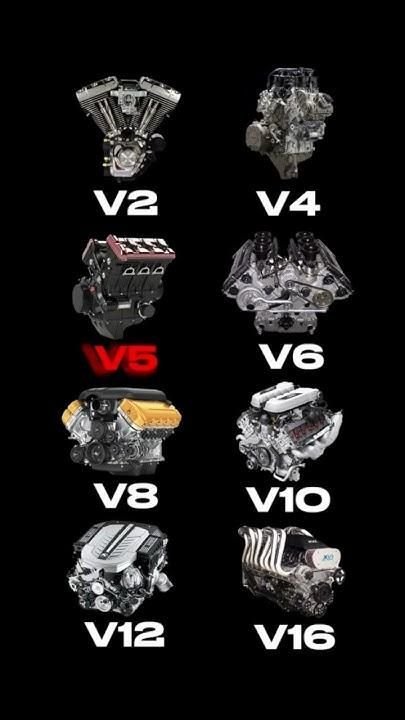
Before we go into specifics, let’s clarify what a V-type engine is.
A V engine has its cylinders arranged in two banks, forming a “V” shape when viewed from the front. This design helps:
- Save space
- Reduce engine height
- Offer better balance and performance
The number (e.g., V6, V8) simply tells you how many cylinders the engine has.
1. V2 Engine (2 Cylinders)
Where It’s Used:
- Motorcycles (Harley-Davidson, Ducati)
- Small cars and light vehicles (rare)
Specs & Characteristics:
- Compact and lightweight
- High torque in low RPMs
- Limited horsepower
- Simple construction
Pros:
- Lightweight and fuel-efficient
- Easy to maintain
Cons:
- Not powerful enough for larger vehicles
- Can vibrate a lot without proper balancing
2. V3 Engine
Where It’s Used:
- Extremely rare, mostly in racing motorcycles (like Honda NS500)
Specs:
- 3 cylinders in V configuration
- Rare due to balancing issues
Pros:
- Unique power delivery
- Lightweight
Cons:
- Poor balance
- Complicated design for limited benefits
3. V4 Engine (4 Cylinders)
Where It’s Used:
- Motorcycles (Yamaha V-Max)
- Some compact cars (Ford Zephyr)
Specs:
- Compact V-shape
- Balanced but harder to manufacture than inline-4
Pros:
- Smoother than V2
- Decent power and efficiency
Cons:
- Complex engineering compared to inline-4
- Expensive to produce
4. V5 Engine
Where It’s Used:
- Volkswagen VR5 (rare example)
Specs:
- 5 cylinders in a staggered V formation
- Engineered for balance between torque and efficiency
Pros:
- Unique balance
- Good mid-range performance
Cons:
- Odd firing order
- Limited adoption due to cost and complexity
5. V6 Engine
Where It’s Used:
- Sedans, SUVs, sports cars (Nissan 370Z, Ford Explorer)
Specs:
- 6 cylinders, common 60° or 90° angle
- Good mix of power and efficiency
Pros:
- Compact and powerful
- Smooth operation
- Great for daily use and sporty performance
Cons:
- Not as powerful as V8
- Can be more expensive than inline-4
6. V8 Engine
Where It’s Used:
- Muscle cars, trucks, luxury SUVs (Ford Mustang GT, Dodge Charger)
Specs:
- 8 cylinders, often 90° configuration
- Strong torque and acceleration
Pros:
- Powerful and loud (in a good way!)
- Great for towing, racing, or high-speed performance
Cons:
- Poor fuel economy
- Heavier and more expensive
7. V10 Engine
Where It’s Used:
- High-performance cars (Lamborghini Huracán, Dodge Viper)
Specs:
- 10 cylinders, usually 72° or 90° V-angle
- Designed for performance and speed
Pros:
- Extremely powerful
- Smooth at high RPMs
- Sounds amazing!
Cons:
- Expensive to build and maintain
- High fuel consumption
8. V12 Engine
Where It’s Used:
- Luxury and exotic cars (Ferrari 812, Rolls-Royce Phantom)
Specs:
- 12 cylinders in perfect balance
- Ultra-smooth and powerful
Pros:
- Flawless balance
- High performance and luxury feel
Cons:
- Heavy, costly, and complex
- Rare due to emissions regulations
9. V14 Engine
Where It’s Used:
- Marine and industrial use (not in road cars)
Specs:
- 14 cylinders, massive displacement
- Not practical for everyday use
Pros:
- Insane torque for ships and locomotives
Cons:
- Not road-legal
- Very bulky and loud
10. V16 Engine
Where It’s Used:
- Ultra-luxury or concept cars (Cadillac Sixteen, Bugatti Type 41), locomotives
Specs:
- 16 cylinders = mind-blowing performance
- Rare and symbolic of extreme power
Pros:
- Insane horsepower and torque
- Unique and prestigious
Cons:
- Almost impractical
- Ridiculously expensive to build and maintain
Quick Comparison Table
| Engine Type | Cylinders | Common Usage | Notable Models |
| V2 | 2 | Motorcycles | Harley-Davidson, Ducati |
| V4 | 4 | Bikes, small cars | Yamaha V-Max |
| V6 | 6 | Sedans, SUVs | Nissan 370Z, Honda Accord |
| V8 | 8 | Muscle cars, trucks | Ford Mustang, Chevrolet Camaro |
| V10 | 10 | Supercars | Dodge Viper, Lamborghini Huracán |
| V12 | 12 | Luxury & exotic cars | Ferrari 812, Rolls-Royce Phantom |
| V16 | 16 | Concept/luxury/industrial | Cadillac Sixteen, Bugatti Type 41 |
Conclusion: What Engine Should You Go For?
At the end of the day, the best engine for you depends on your needs:
- Want something simple and fuel-efficient? Go for a V4 or V6.
- Love power and speed? V8 or V10 will thrill you.
- Looking for luxury and prestige? V12 and V16 engines are as high-end as it gets.
While V16s may be rare and mostly for show, each “V” engine has its own personality, pros, and ideal usage. Whether you’re a casual driver or an engine geek, understanding this spectrum helps you appreciate what drives your vehicle.
FAQs
Q1: Are V engines better than inline engines?
V engines are more compact and powerful, while inline engines are simpler and more fuel-efficient.
Q2: Why are V16 engines so rare?
They’re too big, expensive, and not practical for everyday vehicles.
Q3: Which is the most balanced engine configuration?
V12 engines offer near-perfect balance and smoothness.
Q4: Is a V8 faster than a V6?
Typically yes, but it also depends on the car’s design, weight, and tuning.
Q5: Do motorcycles use V engines?
Yes, especially V2 (V-twin) engines in brands like Harley-Davidson and Ducati.